


Stainless Steel vs. Iron Door Hinges: A B2B Procurement Guide for Importers
Stainless Steel vs. Iron Door Hinges: A B2B Procurement Guide for Importers
Stainless Steel vs. Iron Door Hinges: A B2B Procurement Guide for Importers
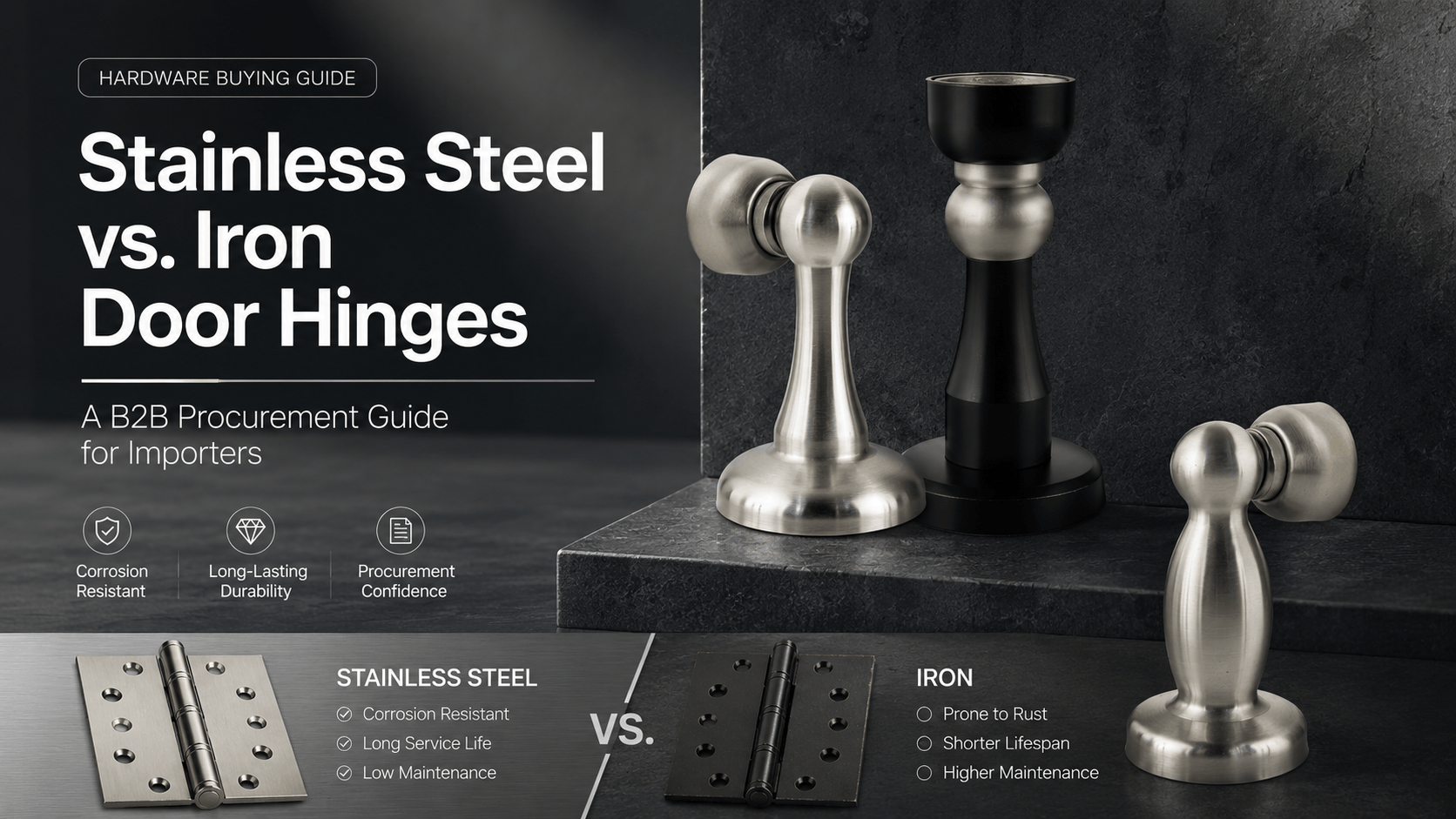
For B2B importers, the choice between stainless steel and iron hinges is a strategic decision that impacts market application, profit margins, and long-term brand reputation. Stainless Steel (304/201) is the industry benchmark for coastal regions and premium projects due to its superior corrosion resistance. Iron (Cold-Rolled Steel) remains the high-ROI choice for budget-sensitive, dry indoor applications.
To maximize your inventory turnover, you need to stock a mix that aligns with your target climate and end-user budget. At Lin Tie Jiang, we provide factory-direct quality control, including salt-spray and load-bearing tests, to ensure consistency across both material tiers.
Understanding the Material Trade-offs
When sourcing hardware, understanding the metallurgical and economic differences is essential for effective inventory management.
Stainless Steel: The Premium Choice for Longevity
Stainless steel hinges are the standard for environments exposed to moisture or extreme weather.
- Grade 304: Offers excellent corrosion resistance, making it the go-to for coastal, humid, and outdoor applications.
- Grade 201: A cost-effective alternative for interior spaces with moderate humidity.
As a professional door hinge factory, Lin Tie Jiang utilizes in-house material testing to verify the chemical composition of our stainless steel, ensuring that the grade you order is the grade you receive.
Iron (Cold-Rolled Steel): The Strategic Choice for Cost Efficiency
Iron hinges, typically manufactured from cold-rolled steel, are the backbone of mass-market residential construction. When properly plated, they are highly durable under normal conditions.
For wholesalers and distributors, iron hinges offer a higher ROI for projects where the budget is the primary constraint. The key to sourcing success here is ensuring the plating quality is robust enough to prevent premature oxidation.
Market Segmentation: Which Hinge Fits Your Target Audience?
Importers often face the dilemma of which material to stock. The answer lies in your local market geography and end-user price sensitivity.
High-Humidity and Coastal Markets
If your distribution network covers coastal regions or areas with high rainfall, stainless steel is non-negotiable. Using iron hinges in these environments often leads to rust complaints, product returns, and long-term brand damage.
Investing in the higher upfront cost of stainless steel protects your reputation and reduces service costs.
Budget-Conscious Residential and Interior Projects
For large-scale housing developments, interior office fit-outs, or retail hardware stores in dry climates, iron hinges are the market leader. They satisfy the “fit for purpose” requirement while allowing you to maintain competitive pricing.
Unsure which material mix fits your current market demand? Contact our engineering team for a customized procurement strategy.
Eliminating Quality Instability: The “Factory Direct” Advantage
A common pain point for B2B buyers is inconsistent quality: hinges that arrive with uneven plating, loose pins, or insufficient load-bearing capacity.
Structural Integrity & Load-Bearing Standards
Quality hinges are defined by manufacturing precision. Our workshop utilizes high-tonnage stamping machines to ensure consistent thickness and structural integrity.
A hinge that bends under the weight of a heavy solid wood door is a supply chain failure. We rigorously test for load-bearing capacity to ensure our hinges meet the demands of standard residential and commercial doors.
Advanced QC Protocols: The Lin Tie Jiang Difference
We eliminate the uncertainty often associated with trading companies by maintaining strict, in-house production lines. From the initial stamping phase to the final plating and packaging, every batch undergoes:
- Salt Spray Testing: To verify the corrosion resistance of the plating on iron hinges.
- Load-Bearing Verification: To ensure the hinge pin and leaf integrity.
- Dimensional Checks: To ensure smooth operation and consistent fit.
OEM Flexibility: Customizing Your Hinge Supply
Moving away from trading companies allows for greater customization. As a manufacturer, Lin Tie Jiang offers tailored solutions to help you build your brand.
Beyond the Product: Packaging and Branding Solutions
We understand that your hinges need to be retail-ready. We provide OEM services, including custom logo stamping on the hinge leaf and bespoke carton packaging.
Whether you need blister packs for retail or bulk master cartons for construction projects, we align our packaging with your logistics and marketing needs.
Ready to build your brand? Send us your design specifications for a free quote on custom packaging.
Supply Chain Efficiency: Mixed Container Loading
We support mixed container loading, allowing you to combine different hinge types, materials, and sizes in a single shipment.
This strategy helps optimize your inventory levels, reducing the capital tied up in slow-moving stock while ensuring you always have the right product for your customers.
Procurement Checklist: How to Vet Your Hinge Supplier
To ensure you are working with a legitimate door hinge factory and not a trading company, use this checklist before placing your bulk order:
- Request a Video Tour: A real factory will be able to show you their workshop, stamping machines, and production lines.
- Ask for Test Reports: Request salt spray test results and load-bearing test reports.
- Sample Testing: Always order samples to test the plating thickness and hinge movement smoothness.
- Verify Production Capacity: Ask about lead times for bulk orders. A manufacturer will provide accurate schedules, whereas a trader may rely on third-party availability.
Conclusion: Making the Right Choice for Your ROI
The decision between stainless steel and iron hinges should be driven by data, specifically the climate of your market and the budget of your end-users.
By partnering with a factory-direct manufacturer like Lin Tie Jiang, you gain access to consistent quality, competitive pricing, and the flexibility to customize your inventory.
Simplify your supply chain. Inquire about our factory-direct pricing to get a quote for your next project.
FAQ
1. What is the real difference in lifespan between iron and stainless steel hinges?
Stainless steel hinges are designed for longevity in harsh, humid, or outdoor environments and will not rust under normal conditions. Iron hinges are durable for interior, dry environments but require high-quality plating to prevent oxidation over time.
2. How can I ensure my iron hinges don't rust?
The key is the plating quality. At Lin Tie Jiang, we use advanced electroplating processes and conduct rigorous salt spray tests to ensure our iron hinges meet high industry standards for corrosion resistance.
3. Does Lin Tie Jiang offer OEM branding on hinges and packaging?
Yes. We offer custom logo stamping on the products and can design packaging cartons to match your brand identity.
4. Can I mix stainless steel and iron hinges in one container?
Absolutely. We support mixed container loading to help you manage your inventory effectively and reduce logistics costs.
5. How do you test the load-bearing capacity of your hinges?
We perform standardized load-bearing tests in our workshop to ensure that every hinge batch can support the weight of standard residential and commercial doors without bending or sagging.
6. What documentation do you provide for large-scale construction projects?
We provide detailed product specifications, material test reports, and quality inspection reports to assist with your project bidding and compliance requirements.
Ready to Optimize Your Hinge Procurement?
Whether you need high-durability stainless steel or cost-effective iron hinges, Lin Tie Jiang is here to support your supply chain with factory-direct quality and OEM flexibility.
Contact:
WhatsApp: +86 180 2600 9795
Website: https://www.lintiejiangtrade.com
Should B2B importers choose stainless steel or iron door hinges for bulk procurement?
B2B importers should choose stainless steel hinges for humid, coastal, outdoor, or premium projects because they offer stronger corrosion resistance and longer service life. Iron hinges are better for dry indoor, budget-conscious residential, retail, and construction projects when high-quality plating and salt spray testing are confirmed. A mixed sourcing strategy usually delivers the best balance of ROI, inventory turnover, and market coverage.